


You Can Plan Weekly — Even Without a Weekly Planner
Weekly planning is often spoken about as something structured.
Intentional. Organised. Almost architectural. But when you look closely at how people actually use planners, something else becomes clear.
Weekly planning isn’t really about neatness or completion. It’s about orientation. It’s about pausing long enough to notice what a week might hold.
About giving shape to time without trying to control it completely. Most of us don’t want rigid plans. We want something steadier than chaos, but softer than a schedule. That’s what weekly planning offers at its best.
And that experience — of holding a week with care — doesn’t belong to a specific layout or format. It can live inside dated weekly planners, undated pages, or even loosely across blank sheets that slowly gather meaning as the days pass. The pages matter, yes. But the relationship with time matters more.
Weekly planning is a practice, not a page
When people imagine weekly planning, they often picture a familiar visual.
A two-page spread.
Seven days laid out evenly.
Lists written with a sense of intention and hope.
And for many people, this format works wonderfully. It offers clarity. It offers reassurance. It offers a sense of rhythm. Here is a detailed read on how planning your week on paper brings calm and clarity – Your Week on Paper. But the real value of weekly planning doesn’t come from the format itself. It comes from the act of stepping back.
Weekly planning is the moment when you stop reacting to individual days and start seeing the week as a whole. It’s when scattered thoughts begin to align. When urgency softens into perspective. You’re not trying to predict everything that will happen. You’re simply acknowledging the shape of the time ahead. That act can happen anywhere. Here is a read on tiny mindful rituals for owning your week.
On pages with dates already printed.
On pages that are completely open.
On pages that change their purpose as the week unfolds.
What matters isn’t where the planning lives — but that it happens at all.
Weeks follow rhythms, not rules
No two weeks feel the same.
Some arrive full and demanding, with obligations layered tightly together.
Some feel quieter, almost spacious, even if they are busy on paper.
Some feel heavy before they even begin.

Our energy shifts constantly. Sleep patterns change. Work ebbs and flows. Creativity rises and falls. Emotional capacity expands and contracts. And yet, the calendar continues to move forward at a steady, indifferent pace.
Weekly planning helps bridge this gap. Not by forcing every week into the same shape, but by allowing us to respond to how a particular week feels.
Some weeks need clarity and direction.
Some need restraint and rest.
Some need a gentle sense of containment rather than ambition.
When planning aligns with rhythm instead of rules, it becomes supportive rather than demanding. It stops asking us to perform and starts helping us listen. This is why weekly planning remains such a powerful practice — not because it standardises time, but because it adapts to it.
Gentle structure: enough shape to feel held
Structure doesn’t have to mean rigidity.
In fact, the most helpful structure is often the lightest. Gentle structure gives a week just enough form to feel anchored, without crowding it with expectations. It offers guidance without pressure. Direction without insistence.
This kind of structure might show up as a short list of priorities. Or a few anchor points you want to return to. Or simple reminders of what matters this week — not everything that needs to be done. The goal isn’t to capture the entire week in advance. It’s to feel oriented within it.
A well-held week feels supportive. It gives you something to come back to when the days feel scattered. It reassures rather than overwhelms. Whether this structure appears inside a traditional weekly planner or emerges naturally on more open pages, the feeling should remain the same: steady, flexible, kind.
White space is what lets a week breathe
White space often gets mistaken for emptiness.
But in planning, white space is what allows movement. It’s what makes room for the unexpected. What absorbs interruptions without derailing the whole system. What allows rest to exist without justification. A week that is packed edge to edge leaves no space for life to enter. Every deviation begins to feel like a failure. Every pause feels unproductive.
White space changes that.
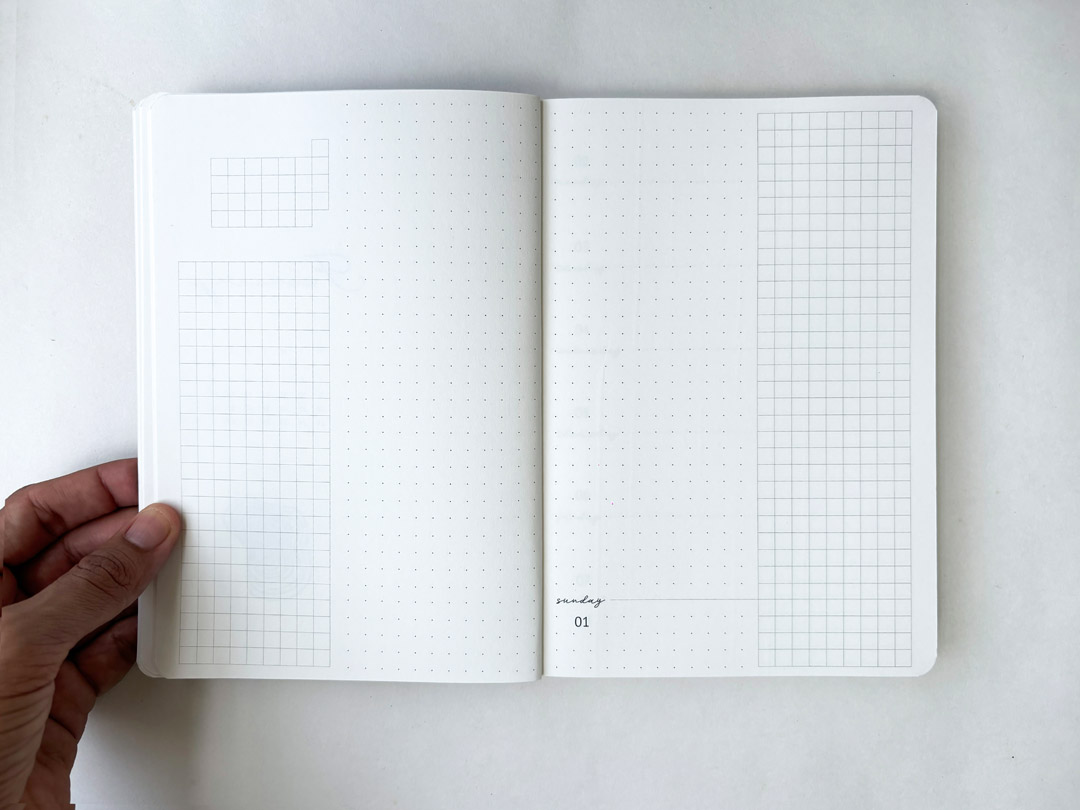
It softens the week.
It allows plans to stretch or shrink as needed.
It makes returning to the page feel possible, even after a gap.
This is why spacious layouts — whether dated or undated — tend to feel calming. They don’t rush you. They don’t demand completion. They simply hold space for whatever the week becomes.
White space isn’t about doing less.
It’s about allowing more honesty. For a more detailed dive into white space, read this piece on the magic of white space.
Permission to skip days — and still plan weekly
One of the quiet pressures many people experience with planning is the idea of continuity. That planning only “counts” if it’s done every day.
That missing pages somehow invalidates the system.
But weeks are forgiving by nature.
You might plan the week at the beginning and barely look at the page again until Friday.
You might add notes sporadically, when something feels important enough to write down.
You might only return at the end, to reflect.
None of this breaks weekly planning. What sustains a planning practice isn’t daily engagement — it’s the ease of return. When planning systems allow you to step away without penalty, they become sustainable. When guilt is removed from the equation, consistency follows naturally.
Undated structures often support this feeling of ease simply because they don’t highlight what was missed. But the deeper truth applies everywhere: planning should invite you back, not punish you for leaving.
Planning at a calm pace
Weekly planning doesn’t need urgency.
It doesn’t need to be done perfectly, or even completely, at the start of the week. It doesn’t need a special setup ritual or a large block of uninterrupted time. Some weeks begin with clarity. Others begin with uncertainty. A calm planning pace allows the week to reveal itself gradually.
You can add to the plan as the days unfold.
You can revise priorities mid-week.
You can respond instead of predict.

Planning might happen in small, quiet moments — a note scribbled during a slow morning, a list added mid-week, a reflection written after the week has already passed.
When planning slows down, it becomes something you live with rather than something you finish. It integrates into daily life instead of sitting outside it. This is where more open, undated approaches often feel natural. They don’t rush you forward. They wait for you to arrive.
No single right way to plan a week
People process time differently.
Some think visually, through layouts and space.
Some think in lists and words.
Some need emptiness before clarity emerges.
Planning styles also evolve. A system that works beautifully in one season of life may feel restrictive in another. Responsibilities change. Energy changes. Priorities shift. The most supportive planning systems are the ones that allow for this movement. They don’t insist on a single “right” way.
They adapt as you do.
This is why many people naturally begin to personalise how they plan — adjusting layouts, repurposing pages, or shaping their own weekly structure over time. Whether you’re working within a traditional weekly planner or shaping your weeks on more open pages, what matters is fit.
A planner should feel like a companion — not a constraint.
Holding a week with intention
At its core, weekly planning is an act of care.
It’s choosing to look at your time with honesty and gentleness.
To acknowledge what lies ahead without overwhelming yourself.
To make room for effort, rest, and everything in between.
You don’t need a specific format to do this. You need a system that lets you return. That allows adjustment. That gives you space to breathe. Some people find that in structured weekly planners. Some in more open, undated layouts. Some move between the two as life changes. All of these approaches are valid.
The week is still yours — however you choose to hold it.
Planning doesn’t need rigidity to be reliable.
And flexibility doesn’t mean losing direction.
Sometimes, it simply means making enough room for life to unfold as it is.